Same Floor, Four Languages: Closing the Communication Gaps That Quietly Cost Warehouses Money
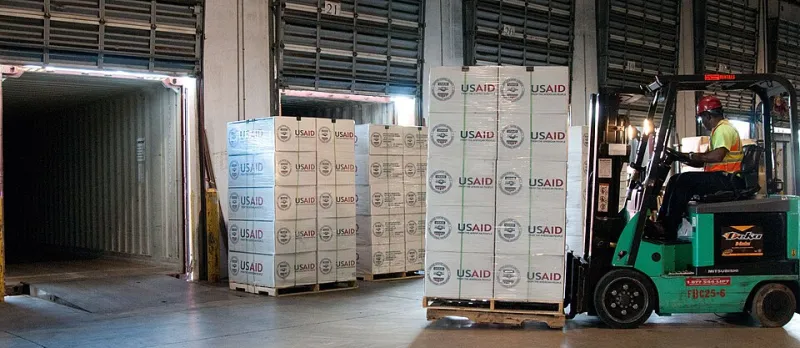
Photo: U.S. Department of Agriculture, Public domain, via Wikimedia Commons
Walk the floor of a major distribution center in New Jersey, Chicago, or the Inland Empire and you'll hear English, Spanish, Polish, Vietnamese, and more — often within the same shift. Multilingual teams are a strength of the American logistics workforce. But when communication infrastructure doesn't keep pace with the workforce itself, the result is a quiet accumulation of delays, rework, and risk that never shows up on a single invoice.
Below are five gaps that show up repeatedly on warehouse floors, with scenarios drawn from common operational patterns and fixes that don't require a capital budget.
Gap 1: Safety Signage Nobody Can Read
Scenario: A distribution center posts OSHA-required hazard warnings and forklift traffic notices in English only. A newly hired material handler, still building English fluency, walks through a marked pedestrian lane boundary — not out of carelessness, but because the sign's meaning never reached him.
The fix: Audit every posted sign for language coverage. OSHA guidance permits — and in practice encourages — multilingual signage where the workforce requires it. Pair translated warnings with standardized pictograms (ANSI/ISO-style symbols) so meaning survives even a reader's first week. The cost of bilingual signage is trivial next to a single recordable incident.
Gap 2: Standard Operating Procedures Written for One Audience
Scenario: A receiving SOP lives in a 14-page English document. Associates who read English as a second language learn the process through imitation instead — which works until an edge case arrives: a hazmat label, a mislabeled pallet, a partial shipment. The workaround they improvise becomes the real process, undocumented and unreviewed.
The fix: Have professionally vetted translations of core SOPs, and treat the translation as a living document updated alongside the original. Machine translation is fine for a quick gist; it is not fine for procedures involving chemicals, equipment, or regulatory obligations. A mistranslated step in a forklift battery-charging procedure is a liability, not an inconvenience.
Gap 3: Driver Instructions That Assume Shared Vocabulary
Scenario: A dock supervisor hands a visiting carrier a gate pass with handwritten notes — "back in at door 12, stop at guard shack." The driver, comfortable operating a tractor but not reading rapid English handwriting, backs into the wrong lane and blocks traffic for twenty minutes during a peak window.
The fix: Standardize driver-facing materials: laminated, pictogram-supported dock maps, pre-printed gate instructions in the languages most common among your carrier base, and numbered check-in steps. Many facilities now use QR codes linking to instructions in multiple languages — a five-minute fix that removes an entire category of dock friction.
Gap 4: Shift Handoffs That Lose Information at the Language Boundary
Scenario: The night shift, largely Spanish-speaking, hands off to a day-shift supervisor who speaks only English. The verbal handoff covers the routine; the exception — a damaged rack section, a delayed inbound — gets lost in translation and surfaces as a morning surprise.
The fix: Replace verbal-only handoffs with structured written logs using a fixed template: completed tasks, open issues, safety observations. Templates constrain ambiguity, and a translated template lets every associate contribute in the language they're most precise in. Supervisors can then triage from the log rather than reconstructing the night from memory.
Gap 5: Training That Tests Compliance, Not Comprehension
Scenario: An associate signs an English-language acknowledgment for forklift training she doesn't fully understand. On paper, compliance is complete. In practice, the training never landed — and the gap reveals itself in an incident report.
The fix: Deliver and assess training in the language the associate best understands, and verify comprehension through demonstration rather than signature alone. Regulators evaluate whether training was effective, and an acknowledgment form in a language the employee cannot meaningfully read offers thin protection in an audit or litigation.
Clear Communication Moves Freight, Too
It's tempting to file these issues under HR or safety. But they are operational performance issues. Every misread sign, improvised workaround, and lost handoff detail adds minutes to dwell, errors to inventory, and risk to the operation — the same way a late truck does.
The unifying principle is simple: the floor already speaks many languages; your documents, signs, and procedures should too. Start with an audit — walk your facility and ask, for every sign, SOP, and form, whether the intended reader can actually use it. The gaps you find are usually inexpensive to close and pay for themselves in throughput and avoided incidents.