Degrees of Failure: Inside the Unforgiving Math of Reefer Freight
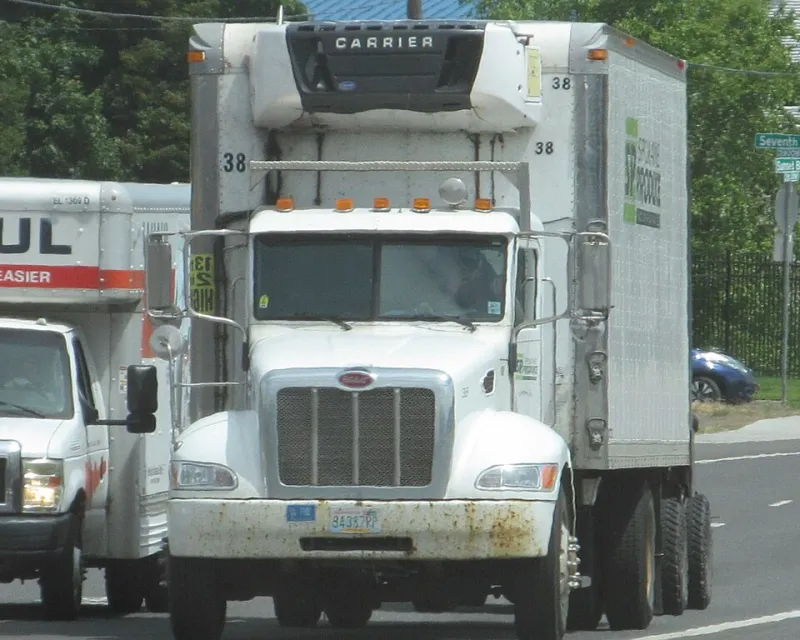
Photo: Ewkada, CC BY 4.0, via Wikimedia Commons
A load of frozen poultry leaves a plant in Springdale, Arkansas, bound for a distribution center outside Atlanta. Somewhere along I-20, the driver shuts off the reefer unit at a fuel stop — a habit left over from dry van days, when idling was just wasted diesel. Four hours later, the trailer's core temperature has drifted six degrees. By the time the receiver runs a pulp test at the dock, the shipment is worth a fraction of its invoice, and the carrier is staring down a claim that can exceed the entire revenue from the haul.
This is the arithmetic of temperature-controlled freight: binary outcomes from marginal errors. There is no partial credit in the cold chain.
Why Reefer Work Resists Automation of Responsibility
Refrigerated trucking is often described as a niche. In dollar terms, it is anything but. Industry analysts peg the US cold chain market well past $20 billion annually, and demand from both directions — food shippers tightening their own compliance postures and pharmaceutical companies moving increasingly temperature-sensitive products — has compressed available capacity in recent years. When a produce season peaks in Salinas or a flu vaccine campaign ramps up in autumn, reefer rates don't just rise; the cost of failure rises with them.
What makes the work genuinely difficult is not the equipment. Modern trailer refrigeration units are reliable machines, and telematics now stream temperature data continuously. The hard part is everything wrapped around the machine: pre-cooling the trailer before loading, verifying setpoints against the bill of lading, understanding why a shipper's spec sheet says one thing while their quality manual says another, and knowing when a two-degree discrepancy is a rounding error versus a rejection.
A driver who has spent a decade in dry van work cannot simply transition into reefer by learning where the fuel switch is. The learning curve is procedural, and the tuition is paid in claims.
The Communication Discipline Nobody Teaches
Ask veteran reefer drivers what actually prevents failed loads, and the answers rarely involve mechanics. They involve conversations.
- Confirming the setpoint in writing. Verbal instructions at the shipper's dock — "run it around thirty-four" — are how loads get rejected. The bill of lading governs, and a carrier who documents the confirmed setpoint, the pulp temperature at loading, and the seal number has a defense when a dispute arises three weeks later.
- Understanding continuous versus start-stop cycling. Fresh produce often ships on continuous run to manage ethylene and respiration; frozen goods may tolerate cycle-sentry operation for fuel savings. Setting the wrong mode on the wrong commodity is a silent error — nothing alarms, until the receiver's shelf-life audit does.
- Managing the receiver relationship. A trailer waiting four hours on a congested dock in Philadelphia is a trailer bleeding cold air every time the doors open. Experienced drivers know which receivers will load them promptly and which will leave them in the yard, and they plan fuel and rest accordingly.
This is where language and documentation discipline become operational assets rather than administrative overhead. A driver who can read a Spanish-language loading instruction at a produce cooler in McAllen, or a shipper who can reconcile an English bill of lading against a buyer's specification sheet drafted for an import program, removes exactly the kind of ambiguity that turns into a rejected load. In cross-border produce lanes out of Texas and Arizona, the failure often begins as a translation failure.
Lessons From the Loads That Didn't Make It
Shippers who have lived through a failed cold chain shipment tend to describe the same pattern in retrospect: a chain of small, individually forgivable shortcuts. A trailer loaded warm because the dock was behind schedule. A driver who didn't download temperature data at delivery. A broker who took the cheapest reefer capacity on the board without asking a single question about the carrier's reefer maintenance history.
The financial exposure is asymmetric. A load of frozen entrées might represent $150,000 in cargo value riding on a $4,000 linehaul. Cargo insurance policies for reefer work often carry specific exclusions for mechanical breakdown and for loading errors — meaning the carrier's coverage may not respond at all if the failure originated at the dock. Shippers with serious temperature-sensitive volume increasingly audit for this: they ask for reefer unit maintenance records, they require pre-cool verification, and they favor carriers with documented temperature-monitoring procedures over whoever called back first.
What a Reliable Cold Chain Partner Looks Like
For shippers evaluating reefer capacity, the vetting questions are refreshingly concrete:
- Does the carrier require pre-cooled trailers before loading, and can they prove it?
- How do they handle setpoint confirmation — verbal or documented?
- What is their process for downloading and retaining temperature data after delivery?
- Do their drivers understand commodity-specific handling, or is reefer an add-on to a dry van operation?
- What do their insurance exclusions actually say about reefer breakdown and loading errors?
None of these questions are exotic. All of them are skipped routinely in a hot spot market, which is precisely why claims frequency in reefer freight remains stubbornly higher than in dry van.
The cold chain rewards preparation with thin margins and punishes improvisation with total loss. As pharmaceutical and food shippers continue to raise their temperature-integrity standards, the gap between carriers who treat reefer work as a discipline and those who treat it as a trailer type will only widen. The loads will keep moving either way. The question is which carriers will still be hauling them next season.